

Table of Contents
Governments worldwide are tightening enforcement against worker misclassification, and the penalties are not theoretical. The Netherlands implemented its enforcement moratorium lift on January 1, 2025, activating real-time audits of contractor arrangements. Spain's "Rider Law" and its broader labor reform have reclassified tens of thousands of platform workers. The UK's IR35 reforms continue to shift liability to the engaging company. And the US Department of Labor's updated classification rule has narrowed the path for legitimate independent contractor status.
If your company engages contractors internationally and your compliance strategy is "we have a contract that says they're independent" — that strategy has an expiration date. In many jurisdictions, it has already expired.
What Is Contractor Misclassification and Why Is It Escalating?
Contractor misclassification occurs when a company classifies a worker as an independent contractor when the actual working relationship — assessed by factors such as degree of control, economic dependence, integration into the business, and exclusivity — meets the legal definition of employment under the local jurisdiction's labor law.
The escalation is driven by three converging forces. First, governments are losing tax revenue as the contractor workforce grows — employers do not pay payroll taxes, social security contributions, or benefits for contractors, creating a fiscal gap that tax authorities are motivated to close. Second, gig economy litigation has established legal precedents that make enforcement easier and more predictable. Third, cross-border remote work has created a new category of misclassification risk where a company in Country A engages a worker in Country B as a contractor, but the working arrangement would be classified as employment under Country B's laws, which the company may not even be aware of.
The Real Financial Exposure: It Is Larger Than You Think
Misclassification penalties are not limited to reclassification. They compound across multiple categories:
Back taxes and social contributions. When a contractor is reclassified as an employee, the engaging company owes all unpaid employer-side payroll taxes, social security contributions, and pension obligations — retroactively, often for the entire duration of the engagement. In France, this can exceed 45% of the contractor's total compensation. In Brazil, the combined employer social contribution burden is approximately 37%.
Statutory benefits and entitlements. Reclassified "employees" are entitled to retroactive paid leave, sick pay, overtime, statutory bonuses (like the 13th-month salary in many Latin American and European countries), and severance. A 2-year contractor engagement reclassified in Germany could trigger claims for 20+ paid vacation days per year, sick pay coverage, and dismissal protection under the Kündigungsschutzgesetz.
Penalties and interest. Tax authorities impose penalties on top of the back-owed amounts. In the US, Section 3509 penalties range from 1.5% to 3% of wages for income tax and 20%–40% of the employee's FICA share. In the Netherlands, post-moratorium enforcement includes fines of up to €9,000 per violation.
Litigation costs. The worker themselves may bring claims for employment rights, wrongful termination, or discrimination protections they were denied as a contractor. Class action or collective claim risk multiplies exposure when the same misclassified structure was used across multiple workers.
For a company with 20 misclassified contractors across 5 countries, total retroactive exposure can reach $500,000–$2,000,000+ depending on jurisdiction, compensation levels, and engagement duration.
Why "Just Convert Them to Employees" Is Not Always the Answer
The reflexive response to misclassification risk is "put everyone on payroll through EOR." That approach works when the workers are genuinely functioning as employees — integrated into teams, working fixed hours, using company equipment, reporting to a manager. EOR is the correct solution for that scenario.
But many companies also engage workers who are genuinely independent: project-based specialists, fractional executives, consultants who serve multiple clients, freelancers who control their own schedules and methods. Converting these workers to employment would be operationally inappropriate, often unwanted by the workers themselves, and in some cases could create reverse-classification issues where an employment contract does not reflect the actual autonomous working arrangement.
The correct approach for genuinely independent contractor relationships is not to force them into employment, but to structure the engagement compliantly — and that is where Contractor of Record (COR) services enter the picture.

What Is a Contractor of Record (COR)?
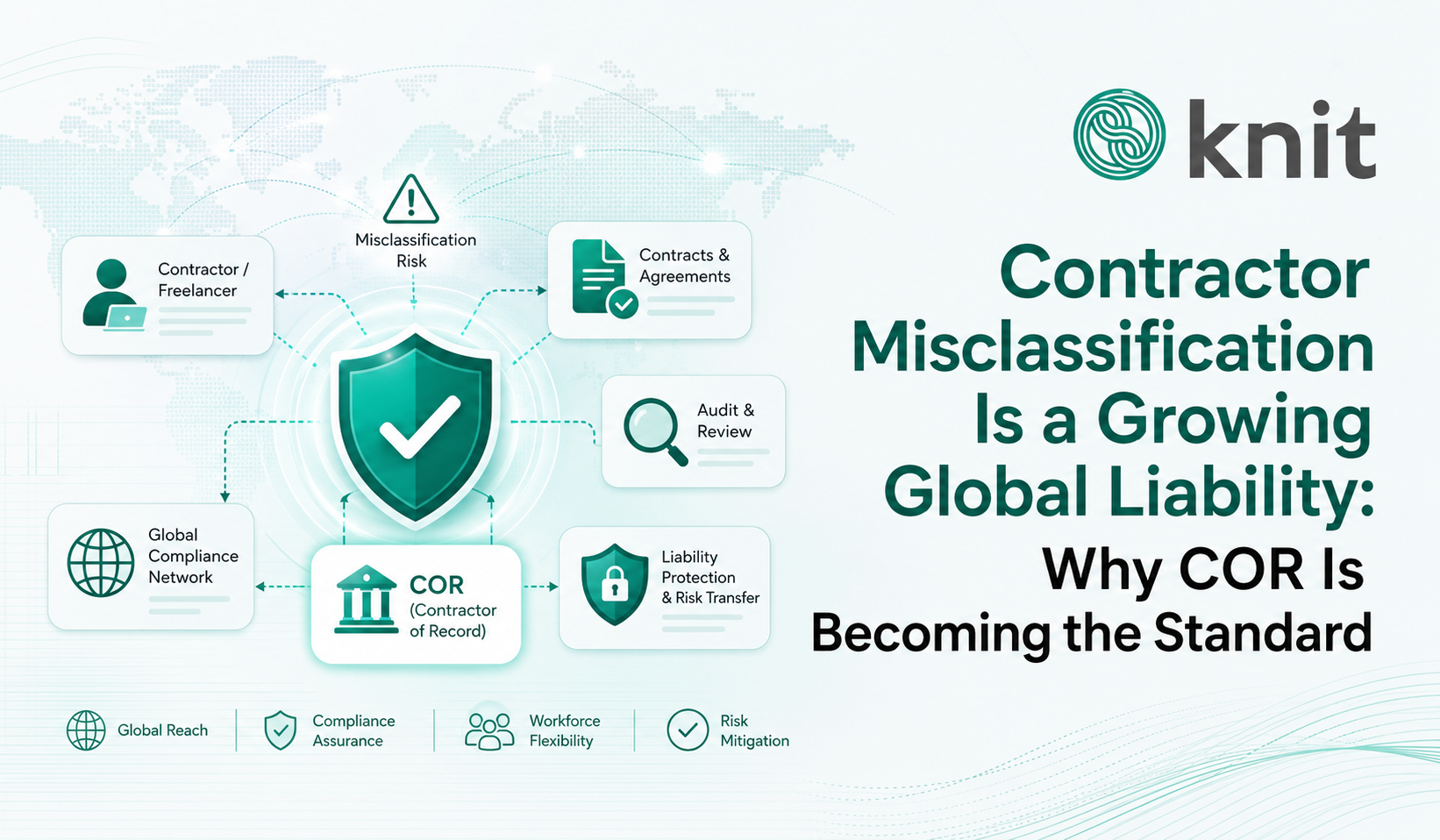
A Contractor of Record (COR) is a service model in which a third-party provider manages the contractual, payment, tax documentation, and compliance aspects of engaging independent contractors in foreign jurisdictions. Unlike EOR — where the provider becomes the legal employer — the COR model preserves the contractor's independent status while ensuring the engagement structure, contract terms, and payment processes comply with local classification laws and tax requirements.
COR services typically include contractor classification assessment (verifying the worker genuinely qualifies as independent under local law), locally compliant contractor agreements, compliant invoicing and payment processing, tax document collection and filing (1099s in the US, equivalent forms elsewhere), and ongoing monitoring for classification risk factors.
The distinction between EOR and COR is critical: EOR is for workers who should be employees. COR is for workers who should remain contractors. Using the wrong model in either direction creates compliance exposure.
How COR Reduces Misclassification Risk in Practice
COR providers mitigate risk at three levels:
Level 1: Upfront classification assessment. Before engaging a contractor through COR, the provider evaluates the working arrangement against local classification criteria. If the arrangement looks like employment — regular hours, single-client exclusivity, company-controlled work methods — the COR provider should flag it and recommend EOR instead. Knit People, which offers both EOR (from $199/month) and COR (from $149/month), performs this classification assessment as part of the onboarding process, routing workers to the correct engagement model rather than defaulting all arrangements to one structure.
Level 2: Locally compliant contract structure. COR providers draft contractor agreements that incorporate jurisdiction-specific terms — payment milestones rather than fixed salaries, deliverable-based scope rather than job descriptions, intellectual property assignment clauses that work for contractor relationships, and termination provisions appropriate for service contracts rather than employment. These structural elements create documentation that supports the independent classification if challenged.
Level 3: Ongoing compliance monitoring. Classification is not a one-time determination. A contractor engagement that starts as genuinely independent can drift toward employment over time — the scope expands, the hours become regular, the contractor stops serving other clients. COR providers that actively monitor these drift indicators provide a compliance safety net that static contracts cannot.
EOR + COR: The Combined Compliance Framework
The most robust approach to international workforce compliance is not "EOR for everyone" or "contractor agreements for everyone" but a classification-first strategy that routes each worker to the correct model.
A practical framework:
Step 1: Classify before engaging. For every international worker, assess whether the arrangement meets local employment criteria or contractor criteria. Do this assessment based on the reality of the working relationship, not on how you want to classify the worker for cost reasons.
Step 2: Route to the correct model. Employees → EOR. Genuine independent contractors → COR. Workers in the gray zone → get a jurisdiction-specific legal opinion before proceeding.
Step 3: Monitor ongoing. Re-evaluate classifications annually or when the scope of engagement changes materially. COR arrangements that drift toward employment should be transitioned to EOR.
Providers that offer both EOR and COR under one platform — Knit People is one example, with EOR across 172 countries and COR starting at $149/month — simplify this framework by allowing transitions between models without changing providers or fragmenting your compliance oversight.
Jurisdictions to Watch in 2026
Several markets are tightening enforcement in ways that affect international contractor engagements:
The Netherlands lifted its enforcement moratorium in January 2025 and is actively auditing contractor arrangements, particularly in tech and professional services.
Australia is expanding its "employee-like" classification framework under the Fair Work Act amendments, creating a hybrid category that could affect traditionally independent arrangements.
India has been implementing the four labor codes that consolidate and modernize employment and social security law, with expanded definitions of "employee" that may capture previously excluded contractor categories.
The European Union Platform Work Directive establishes a rebuttable presumption of employment for platform workers, with potential spillover effects on non-platform contractor arrangements as member states implement the directive into national law.
Companies engaging contractors in any of these jurisdictions without a structured COR approach are carrying unquantified liability on their balance sheet.
Frequently Asked Questions
Q: What is the difference between EOR and COR?
EOR (Employer of Record) makes the provider the legal employer of the worker — the worker becomes an employee with all statutory rights and protections. COR (Contractor of Record) preserves the worker's independent contractor status while ensuring the engagement structure complies with local law. EOR is for employment relationships; COR is for genuine independent contractor relationships. Using the wrong model creates compliance risk in either direction.
Q: How much does COR service cost?
COR pricing is typically lower than EOR because the compliance obligations are less extensive (no employer-side taxes, benefits administration, or termination protections). Knit People's COR service starts at $149/month per contractor. Other providers price COR between $29 and $99/month per contractor for basic processing, though coverage and classification support vary widely at lower price points.
Q: Can a contractor be misclassified even with a written contract?
Yes. In virtually every jurisdiction, authorities assess the substance of the working relationship, not the label on the contract. A document titled "Independent Contractor Agreement" does not prevent reclassification if the actual working conditions meet local employment criteria — regular hours, single-client dependency, employer-directed methods, and integration into the company's core operations are all factors that override contractual labels.
Q: What should I do if I think my current contractors might be misclassified?
Conduct a classification audit immediately, ideally with local legal counsel or a COR provider experienced in the relevant jurisdiction. Assess each engagement against local criteria, prioritize high-risk jurisdictions (Netherlands, Spain, France, Brazil), and transition misclassified arrangements to EOR before enforcement action forces the issue — proactive transition is far less expensive than reactive reclassification.






.svg)
.svg)
.svg)
.svg)
.svg)